Hair · patience
The hair cycle: why change is not visible overnight
Hair grows in cycles. Learn to separate short-term noise from a trend worth paying attention to.
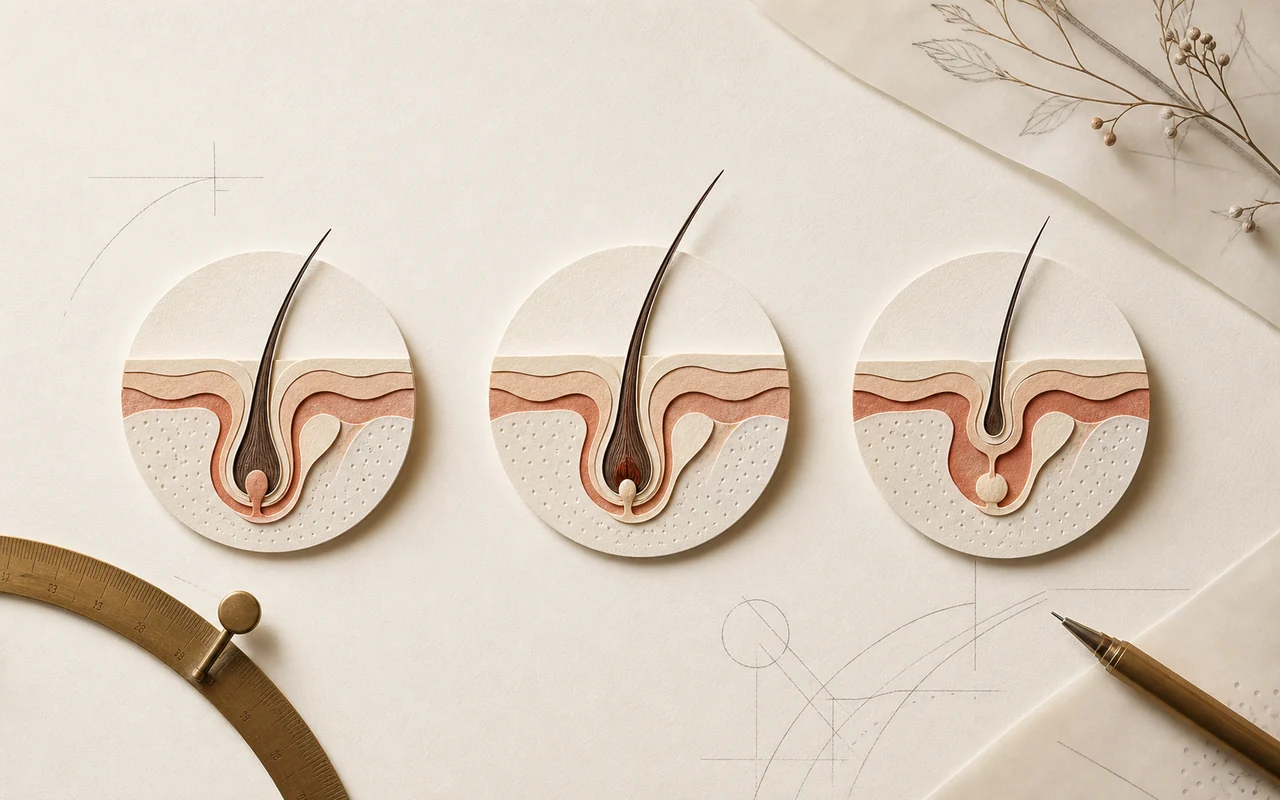
Three phases, on their own schedules
Every hair follicle cycles through growth (anagen), a short transition (catagen) and rest (telogen), after which the old hair is shed and a new one starts. On the scalp the growth phase lasts years, the transition a few weeks and the resting phase around three months.
Follicles do not cycle in sync. At any moment the large majority of scalp hairs are growing while a smaller share is resting or shedding — which is why losing some hair every day is normal.
Some shedding is normal
Dermatologists commonly put normal shedding at somewhere between 50 and 100 hairs a day. It tends to look like more on wash days or after a few days without brushing, because hairs that were already loose come out together.
Counting hairs in the shower or on a brush is noisy for the same reason. A trend over weeks tells you more than any single day.
Why shedding can arrive months after the cause
A shock to the body — a high fever, surgery, childbirth, a crash diet, severe stress or some medications — can push many follicles into the resting phase at once. Because rest lasts about three months, the shedding typically appears two to three months after the trigger, when the cause may already feel forgotten.
This pattern, called telogen effluvium, is usually diffuse rather than patchy and often settles over several months once the trigger is gone. Shedding that keeps going well beyond that deserves a proper look.
Growth is slow, so judgment has to be too
Scalp hair grows roughly a centimeter a month. Any treatment that works by changing the cycle needs months before there is something to see: hair-loss trials typically measure results after six to twelve months, not after a few weeks.
Some hair-loss treatments can even cause a temporary increase in shedding in the first weeks as follicles reset. Stopping at that point means judging the treatment before it had a chance to work.
What is worth tracking
Photograph the same areas — the parting, the crown and the hairline — in the same light, with hair dry and styled the same way, every six to eight weeks. Wet hair clumps and shows more scalp, and overhead light exaggerates thinning at the crown. Consistent conditions are what make two photos comparable.
When to see a dermatologist
Sudden or patchy hair loss, round bald patches, broken hairs, an itchy, red, scaly or painful scalp, loss of eyebrows or eyelashes, or shedding that lasts longer than about six months belong with a dermatologist. So does hair loss alongside tiredness or other symptoms, which can point to treatable causes such as iron deficiency or a thyroid problem. An app should not diagnose any of these — and MiraSkinLab doesn't try.
Sources
- The biology of hair follicles — New England Journal of Medicine (1999)(Opens in a new window)
- Telogen effluvium. New concepts and review — Archives of Dermatology (1993)(Opens in a new window)
- The diagnosis and treatment of iron deficiency and its potential relationship to hair loss — Journal of the American Academy of Dermatology (2006)(Opens in a new window)