Hair · treatments
Thinning hair: what helps, and when to ask a professional
Hair grows slowly, so everything that helps it works slowly too. What care can do, what the evidence says, and where a professional comes in.
Start with the cause
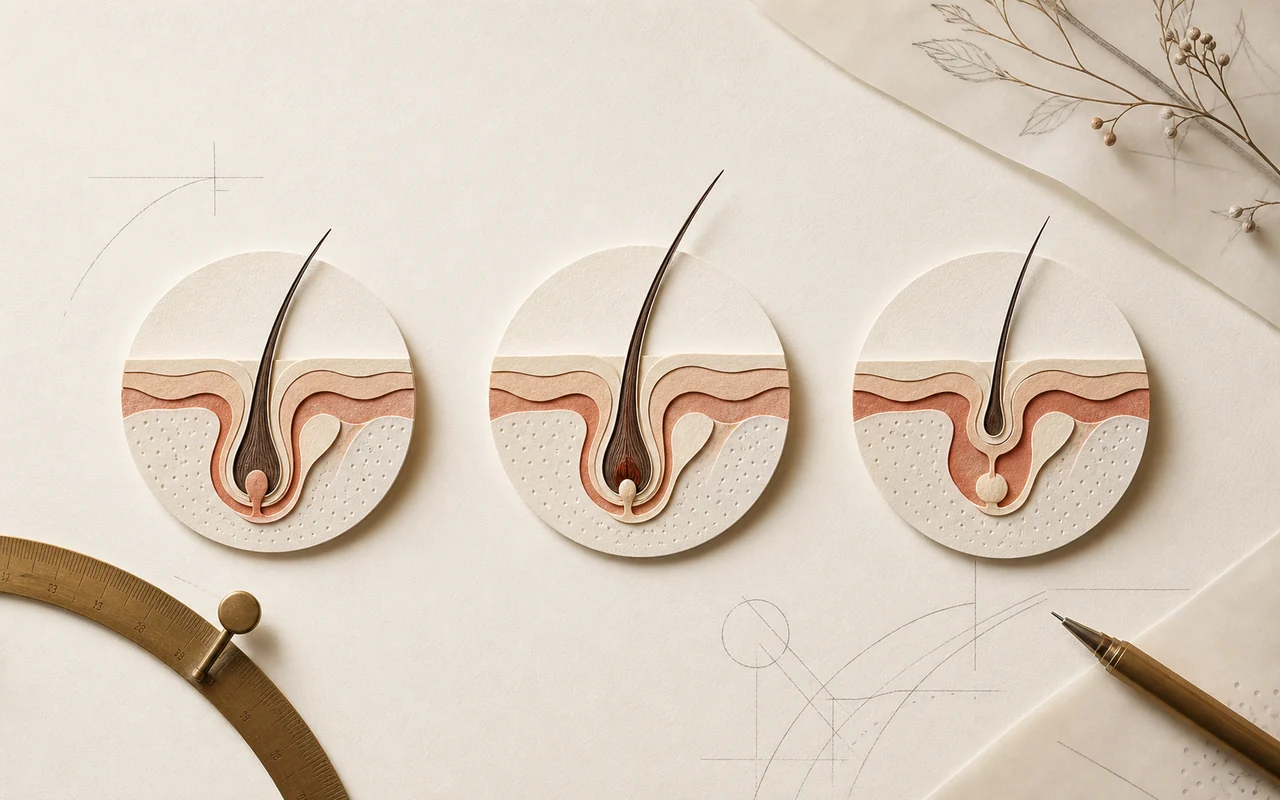
The most common cause of gradual thinning is pattern hair loss (androgenetic alopecia): in men it usually shows at the temples and crown, in women as a widening parting. But shedding after illness or stress, iron deficiency, thyroid problems and patchy alopecia areata can look similar and need different treatment. A dermatologist's diagnosis is worth more than any product chosen by guesswork.
Medicines are a conversation, not a purchase
There are medicines with long-term trials behind them for pattern thinning — some sold over the counter, some prescription-only — and a Cochrane review for women found several options better than placebo. Which one suits you depends on the cause, your sex, other medicines and plans for pregnancy, so ask a pharmacist or dermatologist about the options for your situation. MiraSkinLab doesn't name or dose them.
Whatever is chosen, expect to judge it after six to twelve months, and know that most only work while you keep using them.
Care with smaller evidence
In a small study of nine healthy men, four minutes a day of standardized scalp massage with a massage device left individual hairs slightly thicker after 24 weeks. Caffeine, found in some cosmetic shampoos and tonics, supported hair follicle growth in laboratory studies on human follicles, though that isn't the same as a trial on people's heads.
In-clinic options such as scalp microneedling, low-level light devices and platelet-rich plasma (PRP) have positive trials too, though devices and protocols vary widely and the evidence is less mature. Microneedling on the scalp belongs in a clinic, because broken skin can get infected.
What supplements can and can't do
Vitamins and minerals help hair when you are actually short of them. Iron deficiency is the classic example, and a blood test from your doctor is the way to know — iron should not be taken blindly. For people who are not deficient, reviews find little evidence that hair supplements make a difference — biotin included. High-dose biotin can also distort some blood test results, which is worth telling your doctor if you take it.
Shampoo, conditioner and patience
Shampoo and conditioner change how hair looks and how easily it breaks; they don't change how it grows. Gentle handling helps you keep the hair you have: in a laboratory study on hair tresses, the hair surface got more damaged the hotter the air, and a dryer kept about 15 cm away and moving did the least harm. Whatever treatment you choose, take consistent photos every six to eight weeks and judge it after six to twelve months — the hair cycle doesn't allow a faster honest answer.
Sources
- Interventions for female pattern hair loss — Cochrane Database of Systematic Reviews (2016)(Opens in a new window)
- Standardized Scalp Massage Results in Increased Hair Thickness by Inducing Stretching Forces to Dermal Papilla Cells in the Subcutaneous Tissue — Eplasty (2016)(Opens in a new window)
- Effect of caffeine and testosterone on the proliferation of human hair follicles in vitro — International Journal of Dermatology (2007)(Opens in a new window)
- A randomized evaluator blinded study of effect of microneedling in androgenetic alopecia: a pilot study — International Journal of Trichology (2013)(Opens in a new window)
- Low-level laser (light) therapy (LLLT) for treatment of hair loss — Lasers in Surgery and Medicine (2014)(Opens in a new window)
- The effect of platelet-rich plasma in hair regrowth: a randomized placebo-controlled trial — Stem Cells Translational Medicine (2015)(Opens in a new window)
- The diagnosis and treatment of iron deficiency and its potential relationship to hair loss — Journal of the American Academy of Dermatology (2006)(Opens in a new window)
- The Role of Vitamins and Minerals in Hair Loss: A Review — Dermatology and Therapy (2019)(Opens in a new window)
- Shampoo and Conditioners: What a Dermatologist Should Know? — Indian Journal of Dermatology (2015)(Opens in a new window)